How to choose, before the money moves
Every question on this page is free to ask before you pay and expensive to ask afterwards. That is the entire argument for spending ten minutes here.
If you have not picked a category yet, the category list is the faster way in.
The order is deliberate. Confirm the listing is real and current. Confirm the options say what you think they say. Then decide what you need that the options cannot carry, and write that down in one sentence.
Read the seller page, not the card
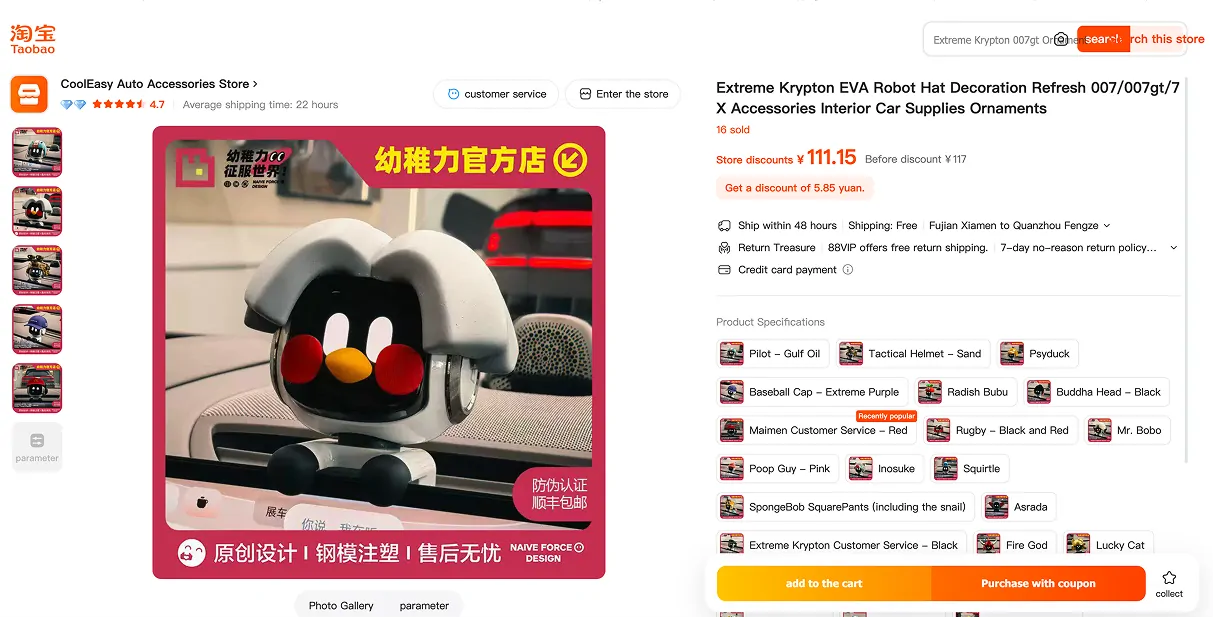
The card is a doorway. The seller page is where the decision gets made, and it holds four things worth your attention: the full option list, the photographs at full size, whatever the seller chose to publish about sizing, and the sales record.
None of that is on the card, and none of it is on the agent listing either until you have already handed the link over.
The four checks, in order
Each one takes under a minute and each one has caught somebody.
Does the link still open the right thing
Cards outlive listings. If the page is gone, search the item name on the catalogue rather than picking the nearest lookalike. If it opens a different product, the card is stale and the rest of it is not worth reading.
Do the swatches match the names
Colour options are photographs with names attached, and at thumbnail size two of them can look identical. Open each one at full size. The name is not reliable on its own, because it is a translation of a seller keyword.
Did the seller publish real measurements
Some listings give a chart in centimetres. Some give bands by body weight and nothing else, which tells you the seller has no flat measurements to give. That is not a scam signal. It is a signal that you need to ask.
What will the finished parcel look like
Weight, size and route decide the second payment. Run a rough guess through the estimator now. It needs no account, and it is the number people most often fail to budget for.
Writing the one sentence that goes in the message box
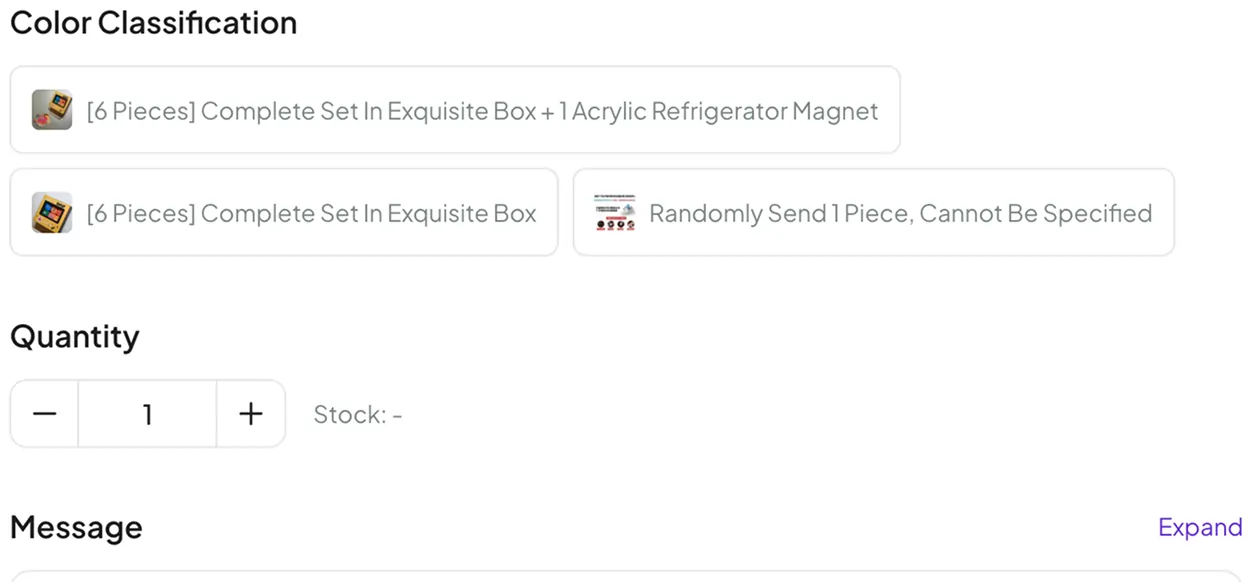
Anything the three form fields cannot carry has to be written. The form holds a colour classification, a size and a quantity, and that is the lot.
A good request names one thing and asks for one action. Please check the insole length in centimetres for the size selected. Please photograph the stitching on the left shoe before shipping. Please buy the version shown in the third photograph, not the first.
A bad request is a paragraph of context with the actual ask buried in the middle of it. The person reading it is working through a queue in a second language.
And the honest caveat: this is a request. Somebody reads it before buying, and nobody promises a particular answer. Decide in advance whether you would still want the item if nobody replies.
Which questions are worth asking, and which are not
Support time is finite and yours is too. This is roughly where the line sits.
| Ask | Why it is worth it | Do not bother asking |
|---|---|---|
| Flat measurements for the size you picked | The seller may have them even when the listing does not show them. | Whether it will fit you. Nobody on the other end knows your body. |
| Which versions are actually in stock | A listing can show options the seller cannot supply. | Which version is better. That is a taste question. |
| A photograph of one specific detail | Targeted photo requests get acted on far more often than general ones. | A full photo shoot. Check in photographs already exist and cost nothing. |
| Whether this seller accepts returns | The return guarantee only exists where the seller offers it, so this is the question that decides everything later. | Whether the agent will overrule the seller. The policy is explicit that the seller decides. |
| Whether a route can carry the item | Batteries and liquids get refused, and the cards say so. | Which route is cheapest today. That changes, and the estimator answers it better than a person can. |
Combining, and when to stop adding to a parcel
Items wait in the warehouse until you choose to ship them, which is what makes combining possible in the first place. Four light things in one parcel ship for far less than four parcels.
Two limits worth keeping in view. Freight goes on the larger of real weight and size based weight, so adding one bulky item can undo the saving from three small ones. And many identical items in one parcel is exactly the shape customs looks at, and the terms are explicit that duties and brokerage are yours to pay.
The other thing to watch is the return clock. It runs per order from check in, not from dispatch, so an item sitting in the warehouse waiting for friends is quietly using up its own window.
Two ways to be wrong about a listing
Both of these end with a parcel you did not want, and they need different fixes.
The listing was not what you thought
- A colour name that did not match the swatch photograph
- A version of the product other than the one in the photographs
- A set where you expected one item, or one item where you expected a set
- Fixable by reading the seller page and asking one question
The listing was fine and the fit was not
- A size chart in centimetres that you did not convert
- Bands by body weight that never applied to your build
- A cut that runs narrow, which no chart records
- Not fixable by asking. This is where the return rules matter
Then hand it over
Once the four checks are done and the sentence is written, the rest is mechanical: paste the link, set the options, write the message, pay for the goods, wait for the check in photographs.
If something does go wrong from here, what goes wrong covers the six usual ones and costs and returns covers what the rules actually allow.
How to read the QC photos you get back
Inspecting the QC is the one step where a few minutes of attention changes the outcome, because after you press go the parcel is sealed and the question becomes a return instead of a reshoot. What to look at is not the same for every category.
Ask for the label, not the pose
Composition, weight and care symbols are printed on the inside label, and a photographed garment usually hides it. A label shot answers the fabric question that the product photograph cannot.
Look where the strain is
On shoes that is the glue line between upper and sole, both sides. On a hoodie it is the hood seam and the cuffs. On a bag it is the hardware and the lining rather than the exterior, which photographs better than it wears.
Ask while the clock is still young
Every request for another photo spends storage time, and the free window is finite. Asking once with a specific list beats three rounds of "can I see more", and it is also the request a warehouse can actually act on.