The mistakes that cost real money
Six failure points, in the order you meet them. Four can be closed before you pay anything. The other two are worth knowing about so they do not read as fraud when they turn up.
None of this is unusual for buying agents, and none of it is specific to this one. It is the shape of the arrangement: somebody else buys from somebody you have never met, in a language you probably do not read, and then ships it a long way.
Most of the prevention happens earlier: choosing an item is where four of these six get closed, and the rules behind the other two are on costs and returns.
The four you can prevent
Each of these has a fix that costs a minute before payment.
The link is dead
Cards outlive listings. A catalogue entry from months ago can point at a shop that has closed the product or closed entirely.
Fix. Open the link first, before you read anything else about the item. If it is gone, search the item name on the catalogue rather than substituting the nearest lookalike.
You picked the wrong option
Colour options are seller photographs with translated names attached. At thumbnail size two swatches can look identical and be different products.
Fix. Open every swatch at full size, and treat the name as a hint rather than a fact. Check the stock count too: an option can be listed and sit at zero.
Nobody answered your message
The message box is a request. Somebody reads it before buying and nobody promises a reply. A long, polite paragraph is the version most likely to be skimmed.
Fix. One sentence, one specific ask. And decide in advance whether you would still want the item with no answer, because that is a real outcome.
The freight was more than the item
Routine with outerwear, shoes and anything bulky, because the charge goes on the larger of real weight and size based weight.
Fix. Put a rough weight and rough dimensions through the estimator before you order. It needs no account and takes under a minute.
The clock one, which is the expensive one
This is the failure that costs the most and gets noticed the least, because nothing appears to go wrong at the time.
The return window opens when the order turns Warehoused and runs for 120 hours. If you look at the check in photographs a week later, or you leave the item in the warehouse waiting for something else to combine with, the window closes while you are doing something entirely reasonable.
The official page says a request might not be accepted after the time expires, which is soft wording for a hard deadline.
Fix. Treat the check in photographs as a task rather than a notification. Open them the day they land, and use the checker if you are not sure where you stand.
The route one, which is the frustrating one
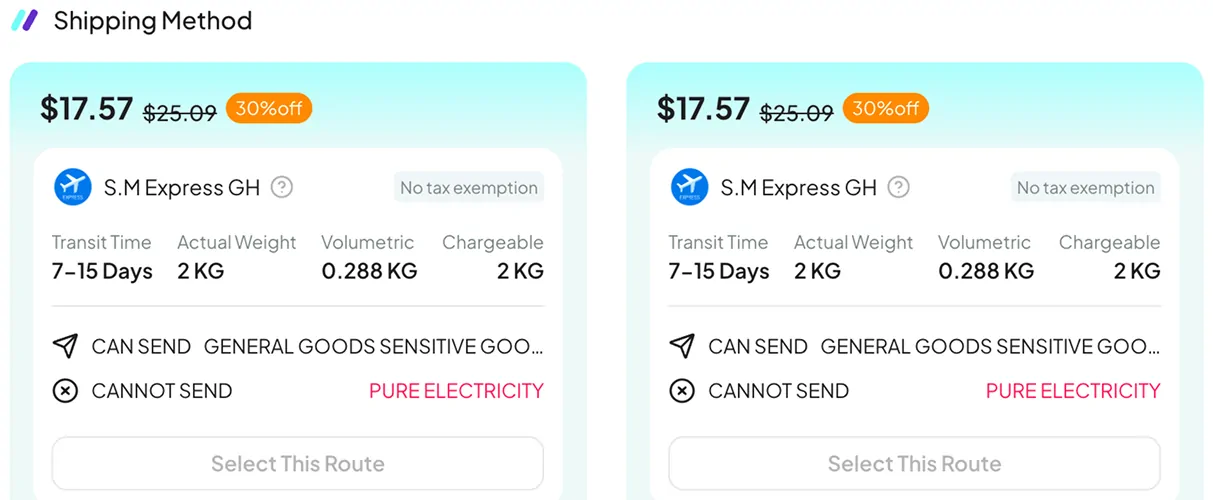
You have paid for the goods, they are in the warehouse, and the route you wanted will not carry them. Batteries are the usual culprit, with liquids, powders and pressurised things behind them.
The cards say so explicitly. There is a can send line and a cannot send line on every one of them, and the wording is unambiguous.
Fix. Read those two lines before you buy anything with a battery in it. If your item is borderline, that is a support question, and it much better asked while the item is still on the seller shelf.
What is not the agent fault, and what is
Being clear about this makes support conversations shorter and calmer.
| What happened | Where the responsibility sits | The useful move |
|---|---|---|
| The item is poor quality | The seller. The terms state the platform is not the manufacturer and not the seller of record. | Raise it with the desk anyway, inside the window, with the check in photographs. They negotiate, the seller decides. |
| The seller shipped the wrong thing | The seller, and the policy says so explicitly. | This is the strongest case you can have. Photograph everything before repacking. |
| It arrived at the warehouse damaged | Listed under other, separate from both you and the seller. | Raise it while the check in photographs are fresh, because they are the evidence. |
| Customs held or taxed the parcel | You. The terms put duties, taxes and brokerage on the buyer. | Nothing to be done afterwards. It belongs in the budget beforehand. |
| The courier lost or delayed it | A third party. The transportation policy states these risks are yours to evaluate and bear. | Insurance is a line item on the parcel screen. Decide about it before you ship, not after. |
| You changed your mind | You, and the policy prices it as an unconditional return. | Return postage both ways plus a 5 RMB service fee. Worth knowing before you order two sizes on purpose. |
When it is genuinely time to worry
Almost everything on this page is friction rather than fraud. The signals that are actually worth acting on are different.
Somebody asking you to pay outside the platform. A link that looks like the agent but sits on a domain you have not seen in the official pages. A request for card details in a chat. Support that will not put anything in writing.
The corresponding habit is simple and works everywhere: start from the official site rather than from a link somebody sent you, and keep every promise in a written channel. The ticket route on the parcel screen is attached to a specific parcel, which makes it the most useful place to be having the conversation.