What this actually costs, and when
Money leaves twice. First for the goods and whatever it takes to get them from the seller to the warehouse inside China. Then, later, for international freight once the parcel has a real weight and you have chosen a route.
There is a service fee on top. The user agreement describes the purchasing service itself as currently free and states that a service fee is added when you confirm payment, and that an order will not be created without it. We do not quote a figure, because the agreement does not publish one and it is not ours to invent.
Nothing on this page is a price list. Everything here is a mechanism, so it stays true after the numbers move.
Two neighbours to this page: the six steps shows where each payment falls, and what goes wrong covers the failures these rules are usually invoked for. If you need a person rather than a policy, the help page has the official routes.
How a route prices your parcel
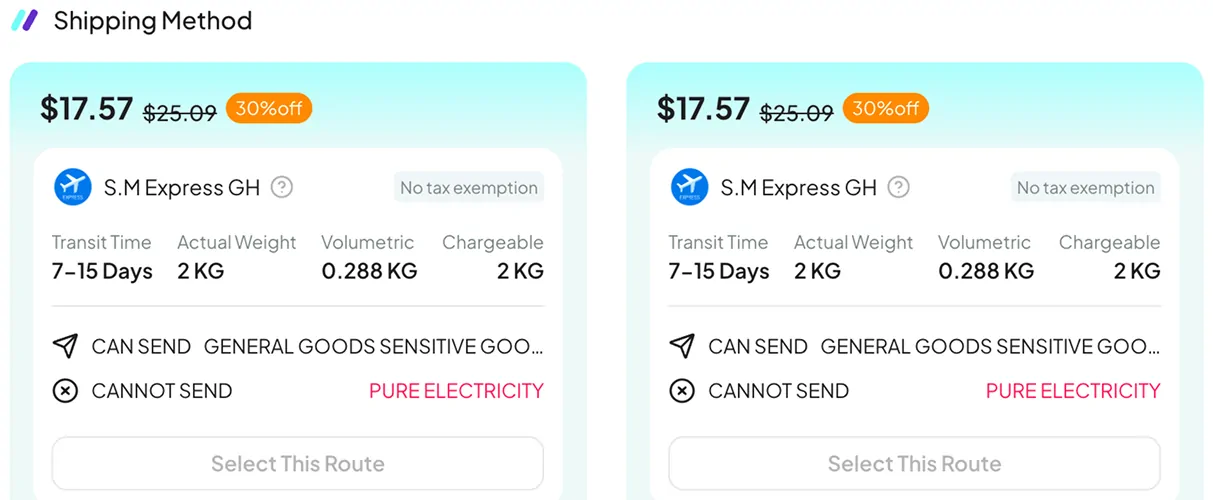
Each route is a card. A courier name, a transit band, a note on tax handling, then three weights: what the parcel weighs, what its dimensions work out to, and which of the two is being charged. The third line is the one that decides your bill.
Underneath sits a can send and a cannot send line, which is where an item gets refused rather than merely expensive.
The exchange rate is a cost, even when it is not on the bill
Everything in the catalogue is priced in Chinese yuan, and you pay in your own currency. Something has to do that conversion, and whatever rate it uses is part of what the order costs you. It is the one charge that never appears as a line item, which is why it is worth looking at deliberately rather than noticing it afterwards.
There are two rates, not one
The mid-market rate is the one a search engine shows you. The rate applied at checkout is the agent own, and the gap between them is the margin. A platform with no service fee is not necessarily cheaper than one with a fee; it may simply be charging in a place that never gets its own line on the invoice.
How to measure it yourself
Take the CNY price on the listing, note the figure your payment method actually took, and divide. Compare that against the mid-market rate on the same day. Do it once on a small order and you will know this agent spread without having to trust anyone claim about it, including ours.
It is charged twice
An order is paid in two stages here, goods first and freight later, so the conversion happens twice on different days. On a long consolidation window those are genuinely different rates.
The five day return guarantee, in plain terms
It is not the agent guaranteeing anything. The official page describes it as a service offered by sellers on the third-party platforms, which the agent passes through.
The official definition: within seven days after the product is signed for, which the same sentence then defines as within five days after the product is stocked in the warehouse.
Read that twice, because the two halves are not the same event. The usable window is the second one. It is stated elsewhere on the page as 120 hours, beginning on the next full hour after the order status turns Warehoused.
Which means the window is running while the parcel is still in China, and is usually over by the time anything lands on your doorstep.
Check your return window
Three inputs, and it reads the official rules back to you: whether the category is covered, how much of the 120 hours is left, and who the policy says carries the cost. It negotiates nothing and it talks to nobody. Everything it says comes off the official returns page as read on 4 August 2026.
The returns policy was rechecked on 11 October 2026. The exact deadline and eligibility depend on the order record, seller terms and item condition; this elapsed-hours guide cannot approve a return.
What the guarantee does not cover
The official page publishes this as a table of ineligible types. It is reproduced here in the same categories, in plain English, because it is the single most useful thing on that page.
| Type | The example the page gives | What that means for you |
|---|---|---|
| Custom made | Products of tailored designs | The desk will still ask the seller. The seller decides. |
| Tags or packaging removed at your request | Clothes with the tags cut off | If you asked for it, you cannot un-ask for it. |
| Newspapers and periodicals | Subscribed books and periodicals | Includes subscription items. |
| Second hand | Second hand products | Worth knowing before buying used, not after. |
| Bought outside the Chinese mainland | Overseas, Hong Kong and Macao | The guarantee is a mainland seller mechanism. |
| Undergarments | Underwear, socks, leggings | Hygiene exclusion, standard across the industry. |
| Adult products | Adult products | Same reasoning. |
| Food | Biscuits, candies and similar | Also the category most likely to be refused by a route. |
| Books in quantity | Fifteen books or more | The threshold is explicit. |
| Opened sealed goods | Anything under the special packing standard | Sneakers and sealed personal care items, see below. |
Two packing standards that quietly decide everything
The returns page carries a short table of special standards, and two entries on it catch people constantly.
New sneakers. The anti-theft clasp, where one exists, and the anti-damage sticker have to be uncut and still functional. Cutting either to try the shoes on ends the option.
Anything sealed. Detergent, sanitary items, paper goods and fragrance, along with hair care, wigs, skin care and body care, all have to keep their disposable seal intact.
Both of these are decided at the warehouse, not by you, which is worth remembering if you were planning to ask for tags to be removed to save weight.
Who pays, according to the policy
The official page publishes a responsible party table with worked examples. The useful summary is that it distinguishes three situations and one edge case.
| Situation | Who the policy says pays | The detail that matters |
|---|---|---|
| Mine. I changed my mind, ordered the wrong thing, or the freight is over budget | you do | An unconditional return is priced as return postage to the seller, plus the postage the seller paid to send it, plus a 5 RMB service fee. |
| The seller. Wrong item sent, or a quality fault | usually the seller, unless they insist otherwise | Wrong colour or size against what was ordered, holes and stains are the examples the page gives for seller fault. |
| Something else. It arrived at the warehouse already damaged | usually not you | Damage during domestic transport inside China is listed under other, separate from both you and the seller. |
| Disputed. I say it is wrong, the seller says it is fine | you do, if the seller wins the argument | The page has a worked example: the customer thinks the product does not match the photo, the seller is asked, and the conclusion is that there is no quality issue. |
Condensed from the responsible party table on the official returns page, read 4 August 2026. Full wording is on that page, and it is worth reading before you open a request.
Three costs people forget entirely
None of these are hidden. All three are on official pages, and all three arrive after the exciting part is over.
Customs duty and brokerage
Cross-border orders may incur duties, taxes, brokerage or other charges. The amount and who collects it depend on the destination, item classification and shipping terms. Check whether any charge is prepaid in your selected route.
Insurance is a line on the parcel
The parcel screen carries a shipping figure and an insurance figure per parcel. The transportation policy is blunt that the couriers are third parties and that seizure, damage, loss and peak-season delay are risks you carry.
The postage on a return you win anyway
For an unconditional return the components are return postage, the postage the seller paid originally, and a 5 RMB service fee. Free shipping at purchase does not carry over. Keep enough balance for it, because the request stalls without funds.
Forwarding is a different service with different rules
If you post a parcel to the warehouse yourself rather than having the agent buy for you, the transportation policy applies instead, and it is stricter.
Everything forwarded is unpacked and inspected on arrival. Specialist inspection is not offered. Most importantly, the policy states plainly that no after-sales service is provided for forwarded goods, and that the agent can only help send them back to whoever sent them. Cash on delivery charges are taken from your account balance without a separate confirmation.
None of that is unreasonable for a forwarding service. It is just a different deal to the one described everywhere else on this site.